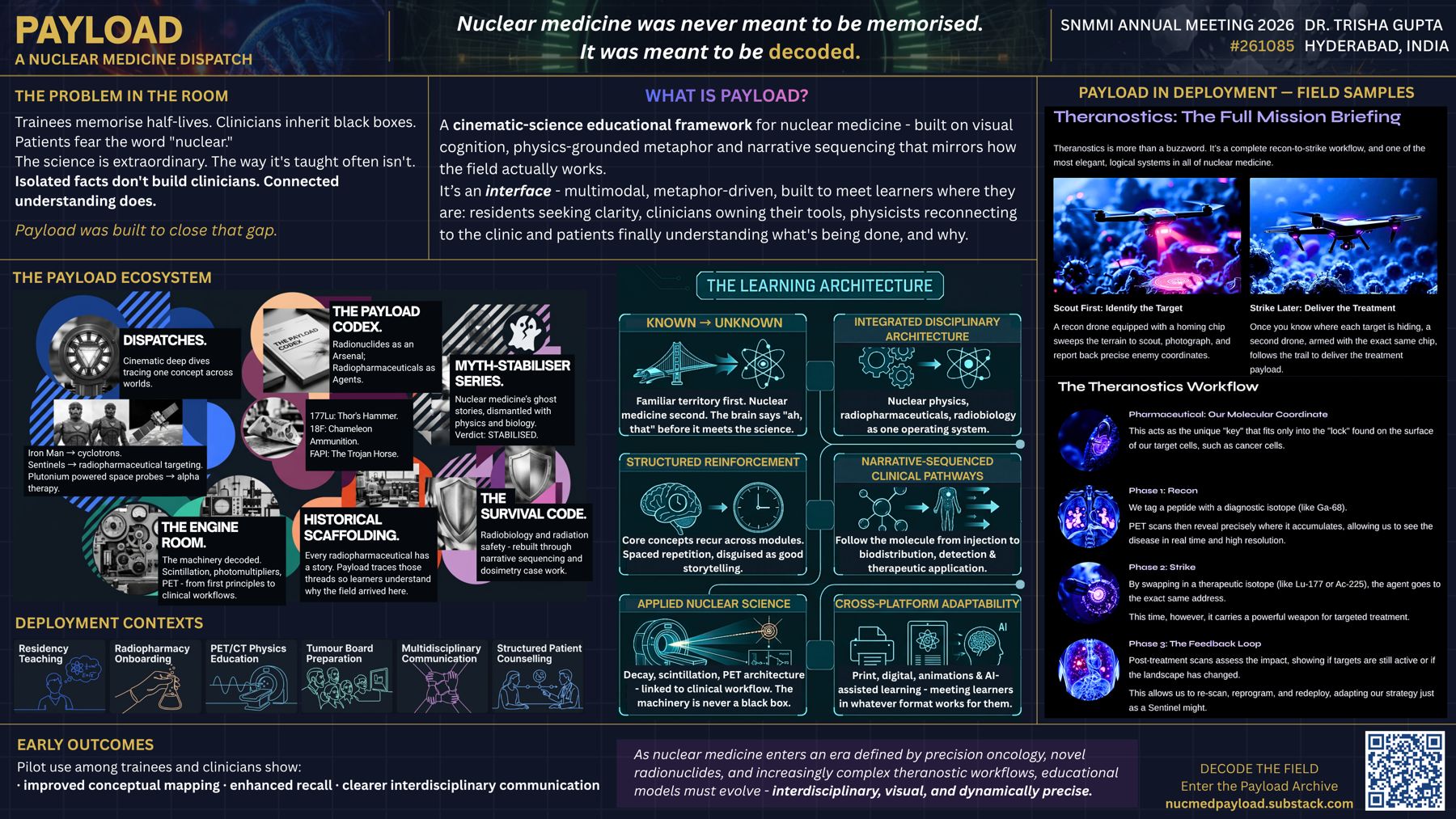
A cinematic-science framework for teaching nuclear medicine, built on visual cognition, physics-grounded metaphor, and narrative sequencing that mirrors how the field actually works.
Trainees memorise half-lives. Clinicians inherit black boxes. Patients hear "nuclear" and brace themselves. The field arrives as a pile of disconnected facts to survive rather than a system to understand.
Isolated facts don't build clinicians. Connected understanding does.
Payload teaches it cinematically instead. Iron Man's cyclotron. Radionuclides as an arsenal. Theranostics as a recon-and-strike mission. The metaphors are physics-grounded and load-bearing, and they make a hard subject genuinely fun to learn.
Built first for students and residents. Read by clinicians, physicists, and anyone who wants the mechanism rather than the summary.
Abstract #261085, SNMMI Annual Meeting 2026, Los Angeles.
That is a real Payload piece, and by the end of it you understand particle acceleration properly. That is how the whole thing works: radionuclides as an arsenal, theranostics as a recon-and-strike mission, nuclear medicine's ghost stories dismantled with physics. The metaphors are load-bearing, and they make a hard subject genuinely fun to learn, whether you are a resident, a physicist, or a patient trying to understand what is about to happen to you.
The workhorse of theranostics, decoded as a weapon in the radionuclide arsenal.
Something you thought you knew about nuclear medicine, taken apart with physics and biology.
What the X-Men's Sentinels reveal about how targeted therapy actually finds its target.
No spam, no filler, unsubscribe anytime.
Prefer to browse first? Read the archive ↗